AI Architecture
AI System Design|Technical Validation|Delivery Architecture
Sphere 10 designs AI systems around the business operation they must perform. We establish the model, data, application and infrastructure boundaries together, then prove the difficult assumptions before you fund the complete build. Our .NET engineering covers the product and integration layers; specialist training and inference components use the tools appropriate to their workload.
Start with a job that has a useful end result: an answered enquiry, a qualified lead, a confirmed booking, an approved quote or an order ready for dispatch. We trace that job through the people, records and systems involved, then decide where retrieval, a model, an agent or ordinary application code belongs. The design covers the complete solution rather than a chat demonstration.
Resolve the Decisions That Determine the Build
We begin with representative work: the documents staff read, the decisions they make, the systems they update and the errors they cannot accept. That establishes whether the solution needs classification, forecasting, retrieval, generation, an agent or ordinary application logic. A working comparison against a simple baseline prevents an impressive demonstration becoming an expensive dependency.
Architecture covers information ownership, user identity, tenant separation, model hosting, tool permissions and the point at which human approval is required. We compare hosted and self-hosted approaches using measured quality, response times, concurrency and operating cost. Provider selection includes data handling and exit options, with assumptions recorded for your review.
Choose the First Business Workflow
We establish what happens today, where work is repeated or lost, and the result your team expects to receive. The first scope might reduce unanswered enquiries, shorten quote-to-order handling or remove rekeying between a mailbox, CRM and accounts. Success is measured against that starting point: completed work, answer quality, staff handling time and operating cost.
Connect AI to an Engineered Application
Our Sphere10 Framework supplies established application lifecycle, dependency injection, persistence and logging mechanisms. We use these foundations for the surrounding system, while Microsoft.Extensions.AI provides model and embedding client abstractions. Microsoft Agent Framework supports agent and workflow composition; existing Semantic Kernel integrations can be assessed and retained where appropriate. Python training or retrieval services sit behind explicit contracts rather than dictating the whole product architecture.
Make System Ownership Explicit
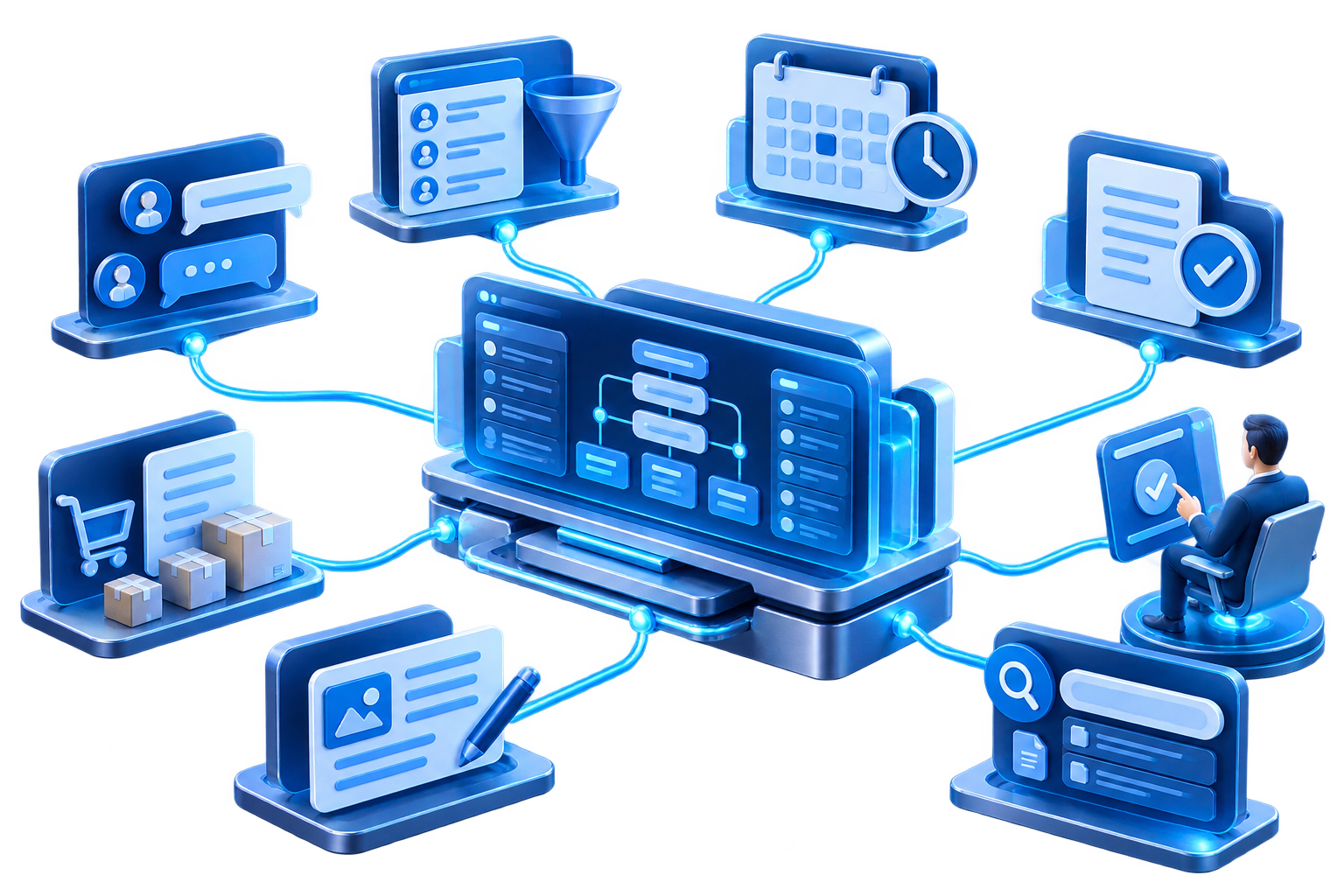
CRM records, mailboxes, calendars, stores, accounting systems and document repositories are connected through supported interfaces. During design we check the account plan, available permissions and integration limits. Prices, stock, resource capacity and eligibility remain owned by the systems responsible for those facts; a model may explain them but cannot invent or override them.
Our .NET services own validation, durable records and business rules. Sphere10 Framework supplies established composition, settings, data-access and diagnostic foundations where appropriate. n8n, Make or Zapier can join suitable existing services; custom C# or Python components handle specialist logic and model processing. We decide which parts your team will maintain and which supplier dependencies remain.
Approval is designed into the workflow. An assistant may answer an approved policy question immediately, while a disputed refund or a proposed supplier payment goes to staff. The design names who may read information, prepare a change and commit it, together with the review queue and useful handover each exception requires.
Your Design Package
Approve the Architecture With Evidence
We review unsupported answers, unavailable providers, slow tools, denied permissions and interrupted jobs alongside successful examples. The handover contains source code for the spike, reproducible test inputs, measured results and the decisions that remain open. Project Design is paid time and materials. Its output gives both parties a concrete basis for a fixed-price rapid application build, rather than a quote built around undefined AI behaviour.
Each unresolved dependency has a named owner and an agreed next step.
From Project Design to Accepted Delivery
Paid time-and-material Project Design uses representative enquiries, documents, campaign briefs or order paths to agree the workflow, system access, data, acceptance examples and build plan. We test uncertain model behaviour in a working slice before pricing the complete delivery. Difficult training, private knowledge and self-hosted inference remain part of the same engineering scope when the task requires them.
Project Delivery is a fixed-price rapid application development build with an initial deposit, one consolidated client change round within the agreed scope, and an acceptance payment on accepted delivery. You review working software against the agreed examples. Additional scope is agreed separately. A dedicated QA round can follow on time and materials or a fixed price, according to the engagement.
Project Execution can continue under a negotiated SLA for deployment, monitoring, support and improvement. We identify model usage, hosting and third-party subscriptions separately from build and support fees. The delivery process and the responsibility for source content, credentials and operating decisions are agreed before handover.
Platforms & Tooling
.NET Microsoft.Extensions.AI Microsoft Agent Framework Semantic Kernel Python OpenAI Claude Gemini
Discuss Your AI Project Back to AI Services