
Data & RAG
Knowledge Ingestion|Permission-Aware Retrieval|Grounded Answers
Sphere 10 builds retrieval systems that connect AI to the information your organisation owns. We engineer the ingestion, document structure, search, permissions and answer presentation together. The result is a knowledge capability inside your application, with sources that can be inspected and updates that can be traced.
Staff should be able to ask an operational question without first knowing which folder holds the answer. We connect manuals, Notion pages, shared documents, help content and business records into an assistant that returns useful references to the maintained source. Onboarding, product support, operating procedures, service manuals and project knowledge are concrete starting points.
Preserve Meaning From the Source
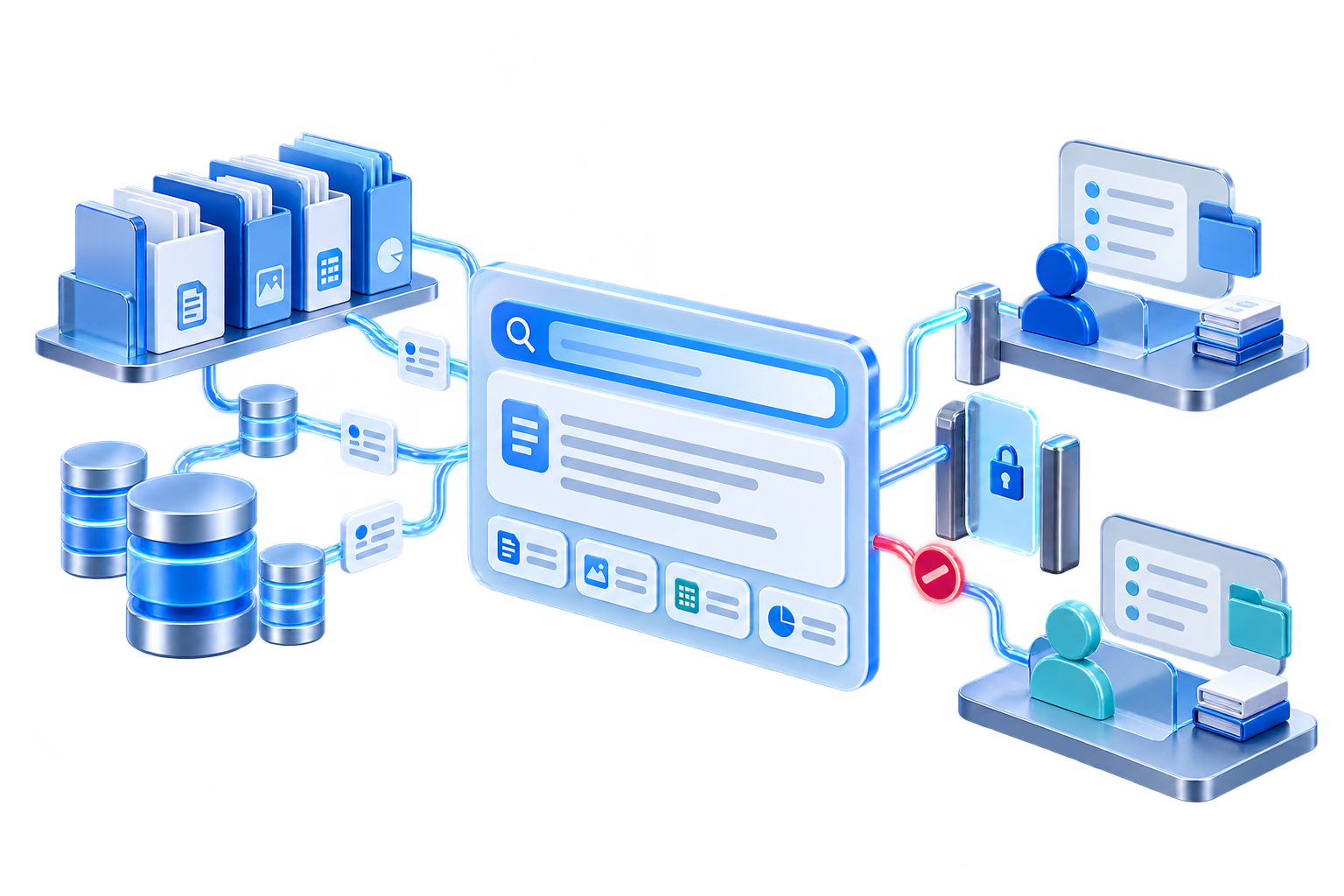
A useful retrieval index starts before the embedding call. We identify authoritative records, duplicate copies, document versions, tables, attachments and access rules. Extraction preserves useful headings, identifiers and source locations so a returned passage can be explained in context. Chunking follows the document and question types; one fixed character count is rarely sufficient for every source.
For Notion content, our Local Notion product supplies an existing .NET foundation for downloading pages, databases, objects and attachments. We can build ingestion around that owned content pipeline. Search permissions, deletion propagation and the retrieval index remain explicit engineering responsibilities rather than capabilities we assume a content export provides automatically.
For a customer assistant, the source collection can include service descriptions, FAQs, specifications, opening hours, locations, preparation requirements and current policies. For staff, the useful result may be finding the current specification or the procedure needed to complete a job. Duplicate, stale or contradictory material is identified before it becomes an answer, and missing evidence remains visible rather than being replaced by a confident guess.
A maintained source catalogue records ownership, user identity, permissions, retention, versions and refresh expectations. LlamaIndex or an existing search platform can support specialist retrieval components alongside our .NET ingestion. The choice follows the source, filtering and operating requirements. The answer links back to the relevant record so its user can inspect the evidence.
Build the Retrieval Pipeline
We implement .NET ingestion and query services with Microsoft.Extensions.AI embedding abstractions where appropriate, connecting to PostgreSQL with pgvector or Qdrant according to filtering, operating and scale requirements. Keyword search, vector search and reranking are compared against real questions. The design records which information is retrieved, how it is filtered and how the final answer cites its evidence.
Turn Documents Into Reviewable Records
Document intake can classify attachments, extract invoice or application fields and identify missing information. The original file and supporting evidence stay attached to the proposed record. Staff can compare a value with its source and amend it before approval, instead of rekeying the same details between systems.
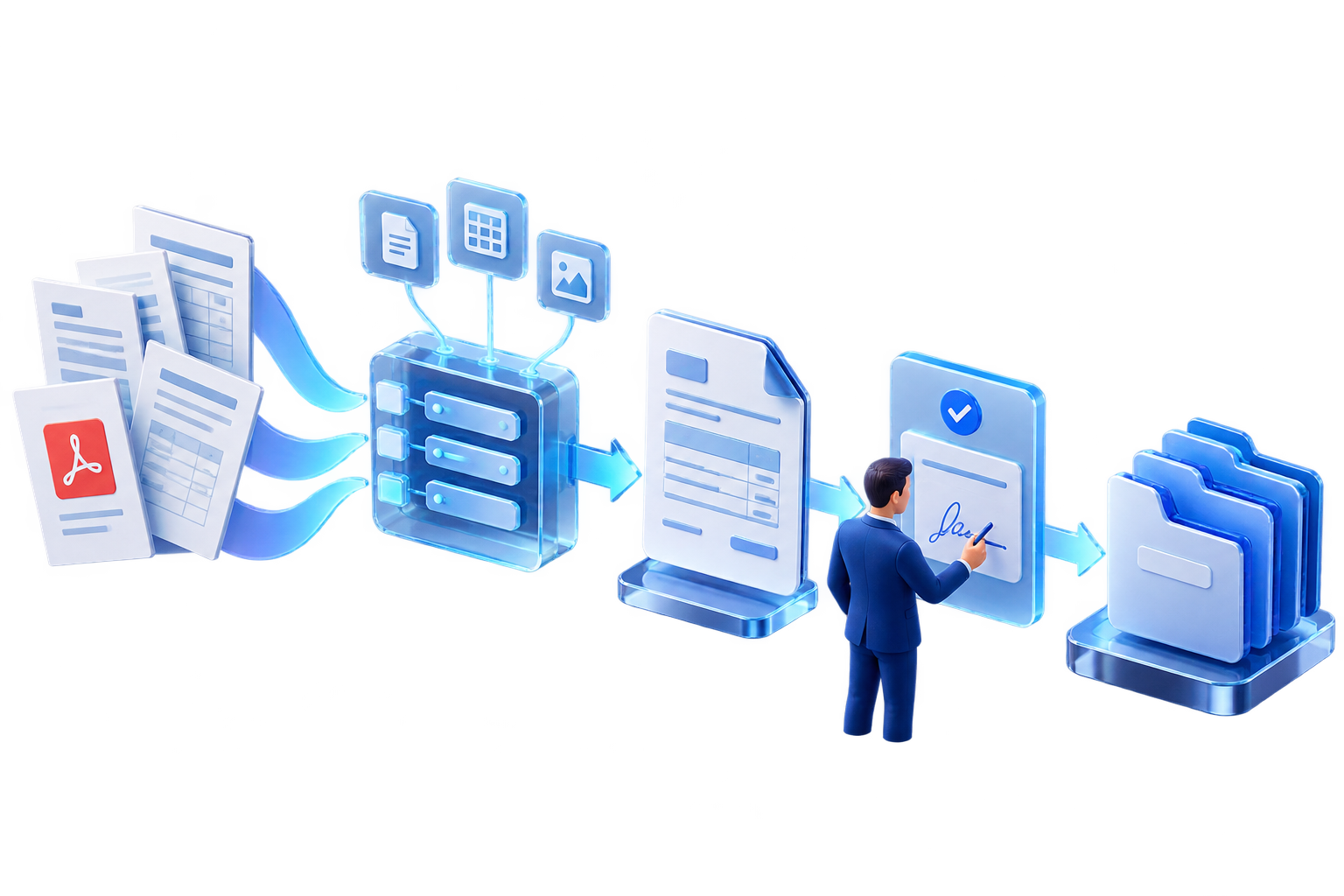
Validation is field-specific. Supplier amounts, addresses and eligibility details are checked against the agreed schema and business records; a plausible sentence is insufficient. We test actual formats and document variations, then route ambiguous or incomplete extraction to an editable review screen. Model or OCR processing sits behind an explicit interface; the .NET application owns document identity, validation and persisted state.
The source and extraction schema are separate from the next business action. Approved fields can populate a quote, onboarding record or agreement; commercial calculations, legal wording, signature and payment approval stay in their controlled workflow. The handover includes format coverage, extraction rules, evidence links and cases for missing fields and amended source documents.
Test Access and Answer Quality Separately
Retrieval that returns the right text to the wrong user has failed. We test tenant and role boundaries before context reaches the model, including indirect access through cached results. Answer checks cover unsupported questions, conflicting sources, missing attachments and documents containing instructions that should be treated as data.
Acceptance measures retrieval relevance and the usefulness of the completed answer separately. You can see whether a failure needs better source material, another search configuration or a change to generation, instead of repeatedly changing prompts without identifying the cause.
A useful knowledge assistant can live inside an internal web application with the correct identity and source links. Once retrieval is useful, a narrowly defined action can prepare a support task or a draft handover. Each action receives its own application contract and permission check; access to a document does not automatically permit an operational update.
Operate the Knowledge Collection
Handover includes connector configuration, index definitions, evaluation questions, update schedules and runbooks for failed imports and rebuilds. We demonstrate a source update and a deletion travelling through to the served result. That gives your team a maintainable knowledge service with a known refresh boundary, rather than a chatbot tied to a one-off document upload.
Project Design proves representative staff questions and source documents before the fixed-price assistant or ingestion build is agreed. Acceptance demonstrates useful citations, access boundaries, missing-information behaviour and a source update reaching the served answer. Your team receives content-update procedures and a maintained evaluation set; model adaptation or a private serving environment is included only where the task needs it.
Platforms & Tooling
.NET Microsoft.Extensions.AI Local Notion PostgreSQL pgvector Qdrant Hugging Face Python
Discuss Your AI Project Back to AI Services