When a process runs across spreadsheets, forms, an accounting package and several inboxes, it is hard to tell whether to reconfigure what you have, connect it or build something new. Sphere 10 maps how the work is done today, compares the realistic options and gives you a prioritised plan that a delivery team can act on.
What we do
Start from a measurable outcome. We agree which business result should improve, who owns it and what evidence will show it.
Map the work before choosing the tool. We trace a representative process, such as order to invoice, through its people, records, decisions and exceptions across Microsoft 365, Notion, Business Central, Xero and your own systems. This exposes duplicated entry, waiting time and poorly informed decisions.
Compare options on the same terms. Configuring your current ERP or CRM, connecting systems with Power Automate, building a Power BI report and commissioning a focused .NET application are assessed against the same workflow, including licences, data migration and support.
Name an owner for every change. Each recommendation records who decides, implements, accepts and operates it.
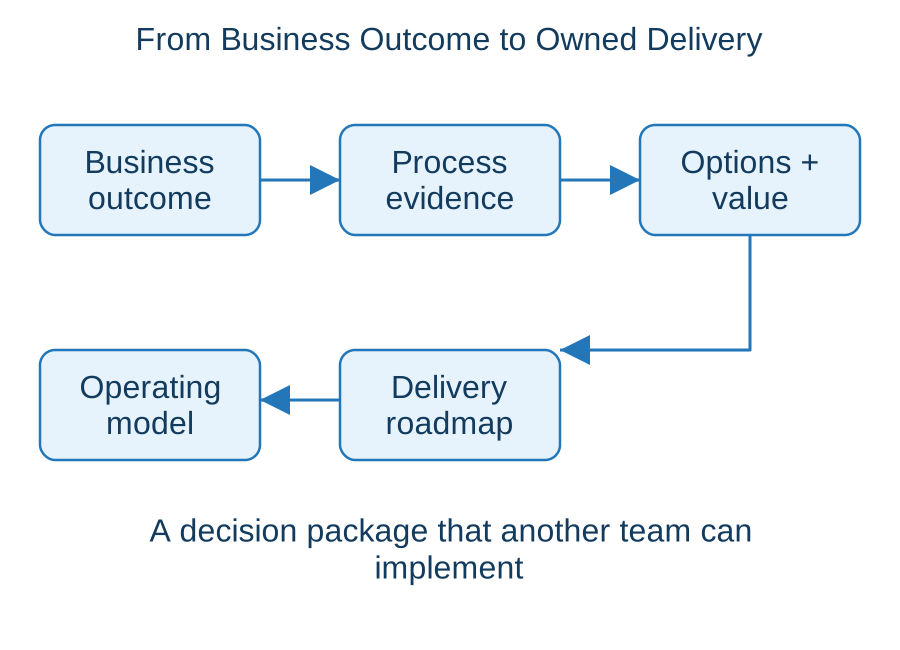
Process evidence and option assessment turn a measurable outcome into a delivery roadmap and operating model.
What you receive
Process maps, requirements and option assessments.
A decision record with the alternatives considered and review triggers.
A phased roadmap with dependencies, training needs and acceptance evidence for each phase.
An implementation backlog with practical acceptance examples.
How we engage
Consulting is Project Design, paid on time and materials. Once the implementation is defined, Project Delivery can proceed at a fixed price with an initial deposit, one consolidated review-and-change round and an acceptance payment. QA is agreed separately. Project Execution sets the ongoing SLA for the systems we operate. The engagement can also close with a handover to your chosen implementation team.
Technologies & Integration
BPMN2.0 — Model actors, decisions, hand-offs and exception paths in an explicit business-process specification.
Power Automate — Evaluate configured approval and integration flows together with connector permissions, failure handling and ownership.
A Notion workspace that has grown one page at a time often ends up with duplicate records, views people do not trust and no clear owner. Sphere 10 designs your workspace around the work your team performs, with connected project, customer, delivery and content records, and connects it to your other business systems.
What we build
Model the record first. We define what each record represents, who owns it and the stages it passes through. Customers, projects, deliverables and decisions are linked, so nothing is kept twice.
Shape views around responsibilities. Each view serves a task, such as capturing a request, planning delivery, reviewing a decision or preparing content for publication.
Make capture consistent. Templates, status values, formulas and rollups give every new record the same structure and defaults.
Review who can see what. Sharing and integration access are checked against the people and connections that need them.
Integrate with clear ownership. Connections through the Notion API state which system owns each field and in which direction updates flow. They cope with rate limits, duplicate notifications and interrupted processing.
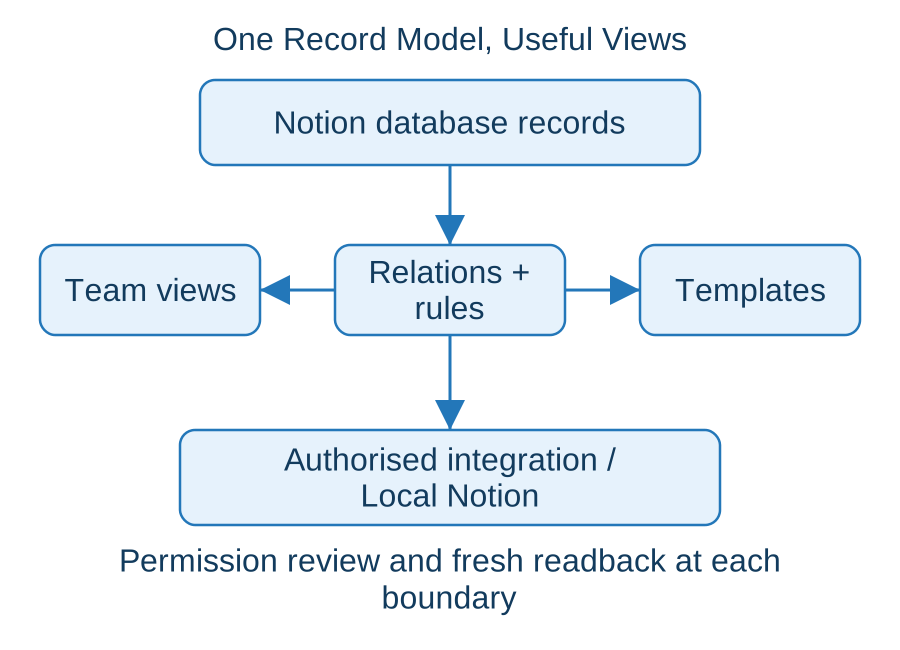
A coherent database model supports focused views, repeatable templates and an authorised integration or publication boundary.
What you receive
An organised workspace with its database model, templates and views.
Tested integrations and their configuration.
Role and editing conventions, with maintenance notes.
Procedures for adding a record type, changing a status or investigating information that has not arrived.
How we engage
We test the model with complete examples from your current workflow. Acceptance follows whole tasks with representative users and records: creation, reassignment, review, completion and exceptions. We also interrupt or reject an integration and demonstrate controlled recovery. Our Local Notion product, which keeps Notion data on your own storage and generates websites and offline publications, is a working reference for this approach.
Technologies & Integration
Notion data-source API — Model schema and Page integration using the database/data-source object boundaries selected by the pinned API version.
Notion relations and rollups — Connect authoritative records and expose related context without maintaining competing copies.
Notion webhooks — Trigger controlled, idempotent integration work from workspace events and verify the current record state.
Ownership Into Operations|Design the Whole Journey
A blockchain product has to keep working after the user signs. Someone holds the keys, a payment must lead to a fulfilled order, and support staff must be able to explain an individual transaction. Sphere 10 designs Ethereum and Bitcoin integrations and gives you an architecture, a working prototype and a delivery plan covering on-chain and off-chain parts together.
What we do
Make ownership and consent explicit. We define what the user controls, what each signature authorises and what is shown before they sign.
Design the whole transaction journey. Preparation, a declined signature, submission, confirmation and completion each have a state the user can understand and a recovery action. Chain confirmation is kept separate from fulfilment, with references that support staff can follow.
Review governance and dependencies. We record who can change or pause a contract and with which approvals, and assess the node providers, wallets and indexing services the product relies on, including fees and data visibility.
Prove the critical assumption. A focused prototype tests the most important interaction, including a delayed or interrupted outcome, before the full build is commissioned.
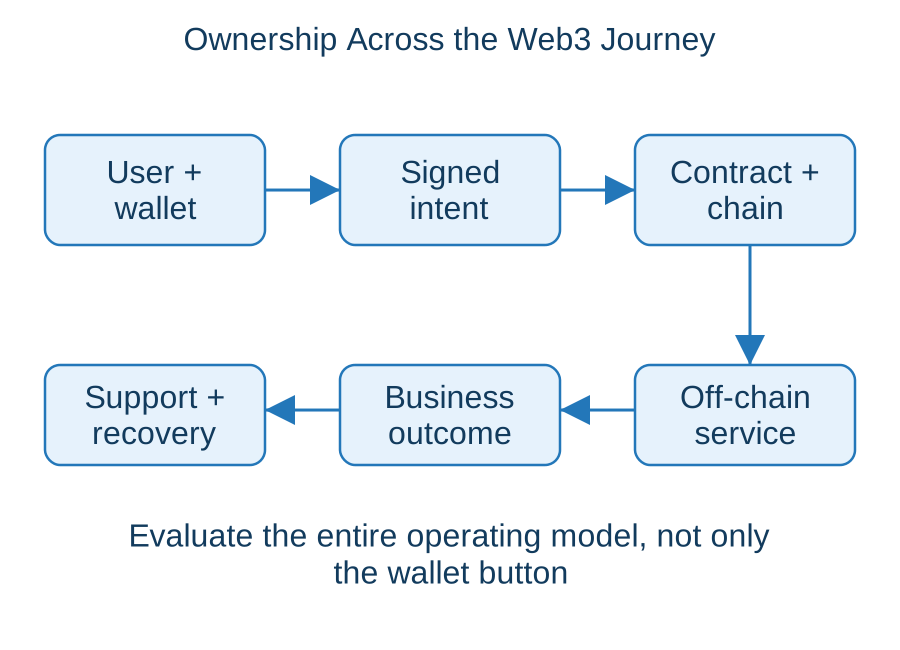
User consent, signed intent and chain state connect to off-chain fulfilment and an owned support and recovery process.
What you receive
A user-journey model, component architecture and responsibility matrix.
The decisions behind custody and governance.
The prototype, its evidence and the interface contracts.
A phased delivery scope with acceptance criteria covering transactions, fulfilment and support.
Product facts and decision points for commercial or legal review.
How we engage
We bring protocol, cryptographic and .NET engineering into the product discussion early, so custody, signing authority and support are settled before platform choices become expensive commitments. The plan assigns monitoring, key administration and dependency maintenance to named owners. The work can then progress into implementation of the selected contract, service and interface components.
Technologies & Integration
Ethereum JSON-RPC — Specify chain identity, transaction submission, receipts/logs and the observations used by the application projection.
Solidity security considerations — Review state transitions, external calls, authority and upgrade assumptions in the selected contract design.
OpenZeppelin access control — Define owner/role administration, privileged transitions and the transfer or revocation of authority.
Nethereum — Prototype ABI calls, transaction handling and EVM event processing from C# services with explicit replay and reconciliation.
Bitcoin RPC — Define Bitcoin-specific node, wallet and transaction observations, with selected-version command and ownership requirements.
Advice You Can Implement|A Clear Technical Roadmap
Upgrading an ageing application, moving to the cloud or tightening sign-in rules affects the whole organisation, and advice is useful only when it can be carried out. Sphere 10 reviews your environment across Microsoft 365, Windows and Linux servers, Azure or AWS and your business applications, then gives you a target architecture and a phased roadmap with an accountable owner.
What we do
Assess the estate. We inventory critical applications, hosting, administrative access, patching and backup, and trace the identity, data and network dependencies of important workflows. CIS Controls and the NIST Cybersecurity Framework provide the baseline.
Tie each recommendation to a constraint. Every proposed change names the business requirement, the current limitation and its operating owner.
Compare options against the same requirements. A supported .NET upgrade, a product replacement, an API integration and an infrastructure move are weighed on compatibility, data migration and support. Cloud and on-premise hosting get the same workload and recovery criteria.
Plan the transition in stages. The roadmap starts with a bounded proof of a critical identity, migration or integration assumption. Each phase has cutover, rollback and acceptance conditions, with backup, monitoring and support training in scope.
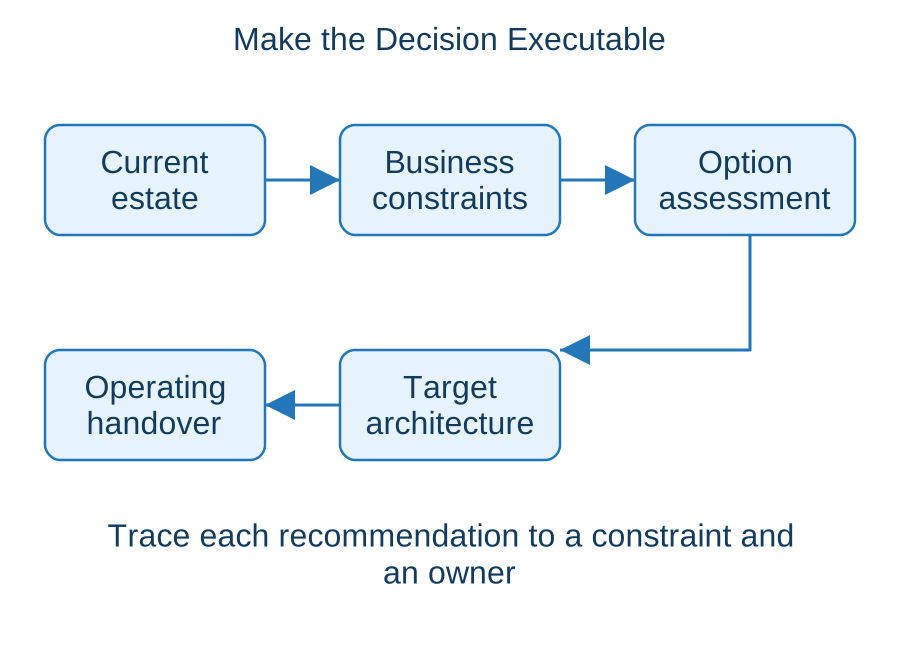
An estate assessment and explicit constraints lead to an evidence-based option choice, target architecture and operating handover.
What you receive
A current-state assessment with system maps and configuration findings.
Option assessments, a target architecture and a reasoned decision record.
A prioritised implementation backlog with dependencies and acceptance examples.
Proof results and unresolved decisions with their responsible parties.
How we engage
We review the plan with the people who will own the systems. The package supports procurement, internal delivery or a Sphere 10 implementation. If you continue with us, work proceeds through paid Project Design into defined delivery with separately scoped QA, and ongoing operational responsibilities are agreed through Project Execution.
Technologies & Integration
Microsoft Entra Conditional Access — Assess identity/device signals, access-policy rollout and the administrative recovery boundary for the selected tenant.
Microsoft Intune — Define endpoint enrolment, configuration/compliance and operating ownership alongside the organisation's identity model.
.NET support policy — Plan runtime and dependency upgrades using the selected application's compatibility and official lifecycle dates.
CIS Controls — Prioritise applicable safeguards and map product-specific configuration findings to owned corrective work.
NIST Cybersecurity Framework — Structure the agreed cybersecurity outcomes, current evidence and improvement priorities.